

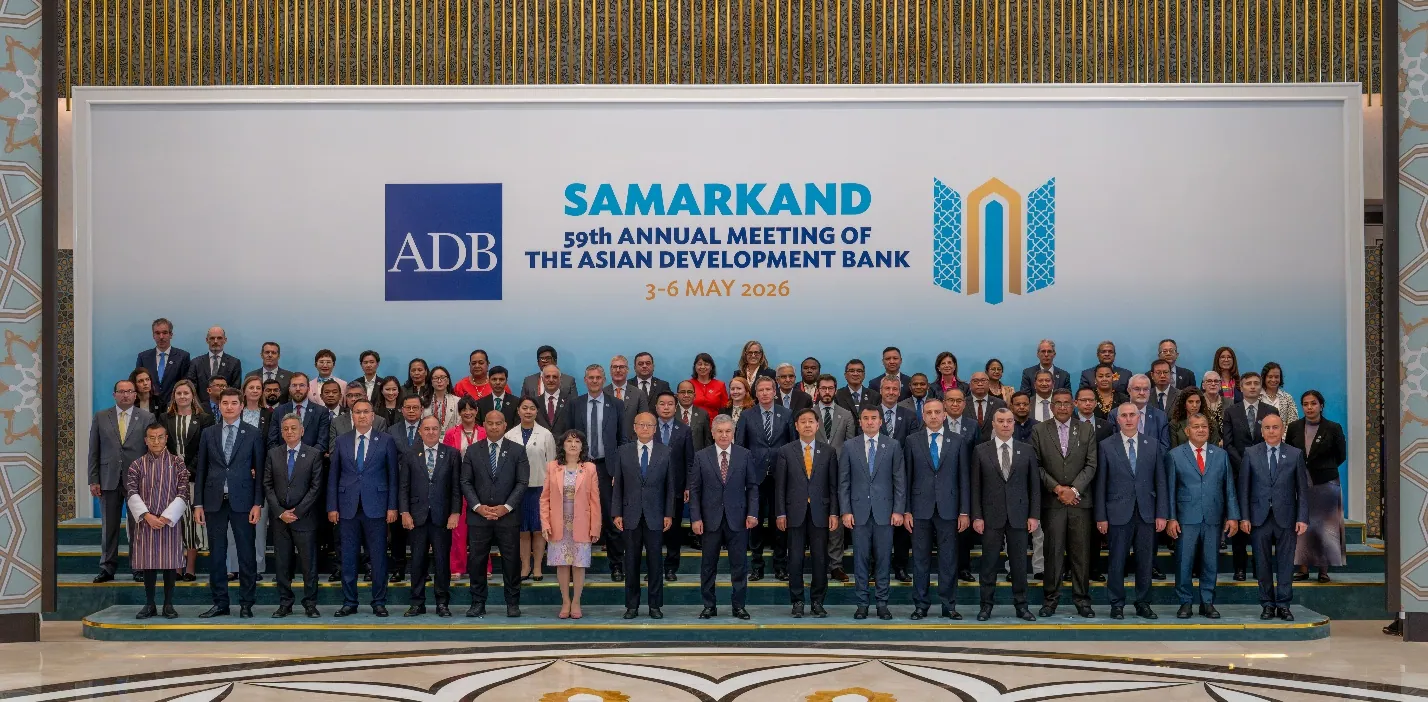
ADB 59th Annual Meeting in Samarkand: Key Outcomes and Implications
Executive Summary: The 59th Annual Meeting of the Asian Development Bank (ADB) was held 3–6 May 2026 in Samarkand, Uzbekistan, drawing over 4,000 delegates from more than 100 countries. Under the theme "Crossroads of Progress: Advancing the Region's Connected Future," discussions centred on digital and physical connectivity, green transformation, climate resilience and food security. Among the key announcements was a $70 billion Asia–Pacific connectivity programme (with $50 billion for a Pan-Asia Power Grid and $20 billion for the Asia-Pacific Digital Highway). Global partners also made new commitments — for example, Germany pledged €5.5 million to the ADB Nature Solutions Finance Hub for climate adaptation projects in Central Asia, and ADB signed financing packages (with ACWA Power and AIIB) totalling roughly $223 million for a 300 MW wind power project ("Bash 2") in Uzbekistan.
The meeting emphasised the role of the private sector in financing infrastructure and innovation: delegates at a CEO Forum on 5 May (which included Finasia's CEO) discussed de-risking investments and regulatory reforms to attract capital. In his opening address, ADB President Masato Kanda stressed that "we must build deeply connected and resilient systems" across borders, while Kanda's LinkedIn post emphasised that connectivity now means "goods, data, and capital" moving faster and more inclusively, requiring patient private capital. Our CEO participated in the ADB CEO Forum for the Private Sector on 5 May. This report reviews the meeting's background, major outcomes, and their implications for the private sector and the Central Asian region.
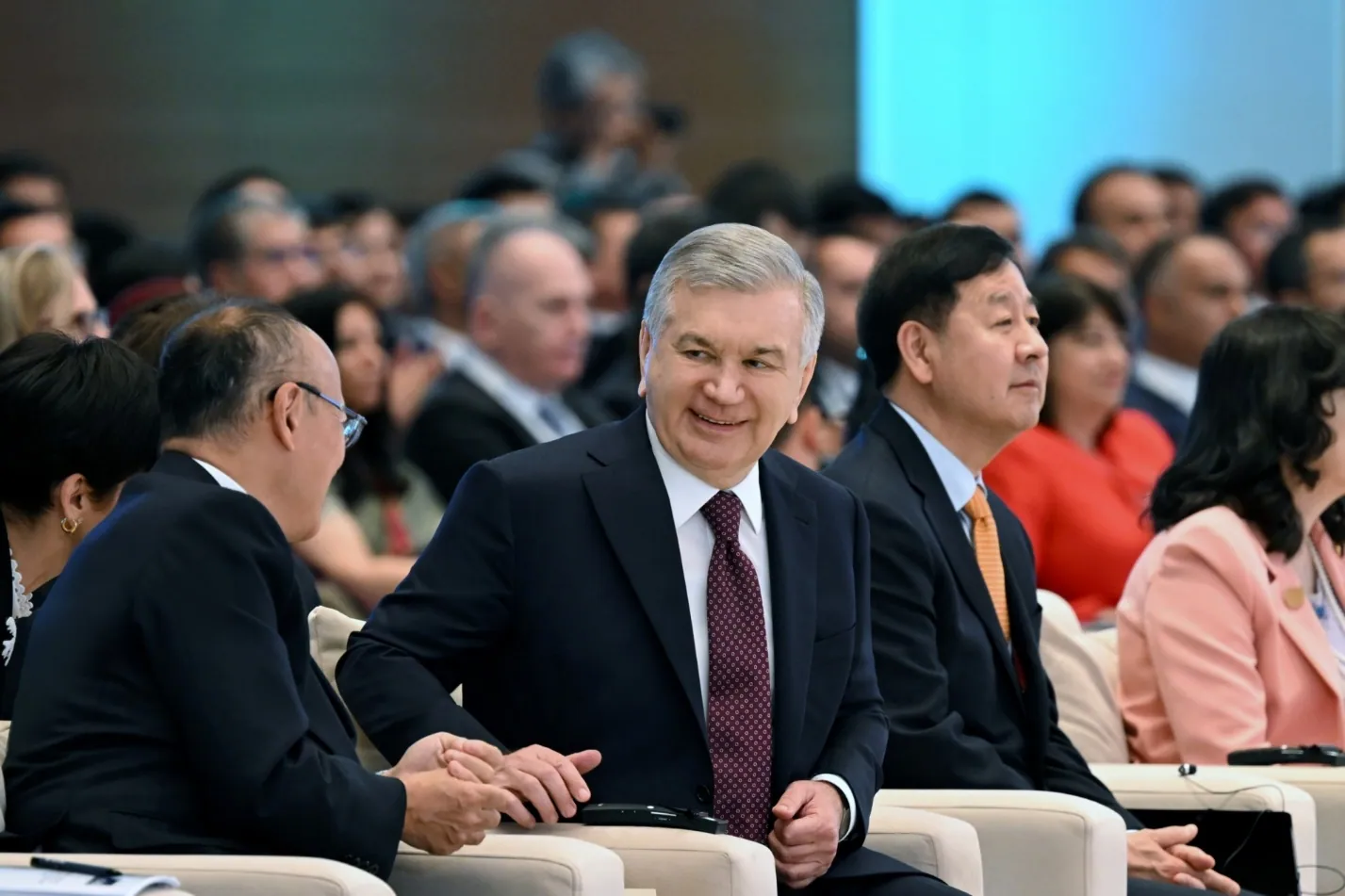
The ADB Board of Governors convened in historic Samarkand (the first such meeting in Uzbekistan was in Tashkent in 2010) to discuss development goals for Asia and the Pacific. Uzbek President Shavkat Mirziyoyev hosted the summit, highlighting Uzbekistan's economic reform and its rising profile in Central Asian cooperation. Mirziyoyev noted that under recent reforms Uzbekistan has attracted some $150 billion in foreign investment and grown its economy to $147 billion. Poverty had fallen from about 35% to 5.8% of the population, he said, and GDP growth remained robust (8.7% in Q1) despite global headwinds. He also praised ADB's role: Uzbekistan's joint project portfolio with the bank reached nearly $16 billion.
Bilateral talks included a new Uzbekistan–ADB Partnership Program (through 2030) valued at ~$12.5 billion, aimed especially at private-sector development, mortgage and small business support, and innovation. Kanda thanked Mirziyoyev for hosting and affirmed that under the President's leadership "ADB will further deepen collaboration with Uzbekistan".
Key Themes and Outcomes
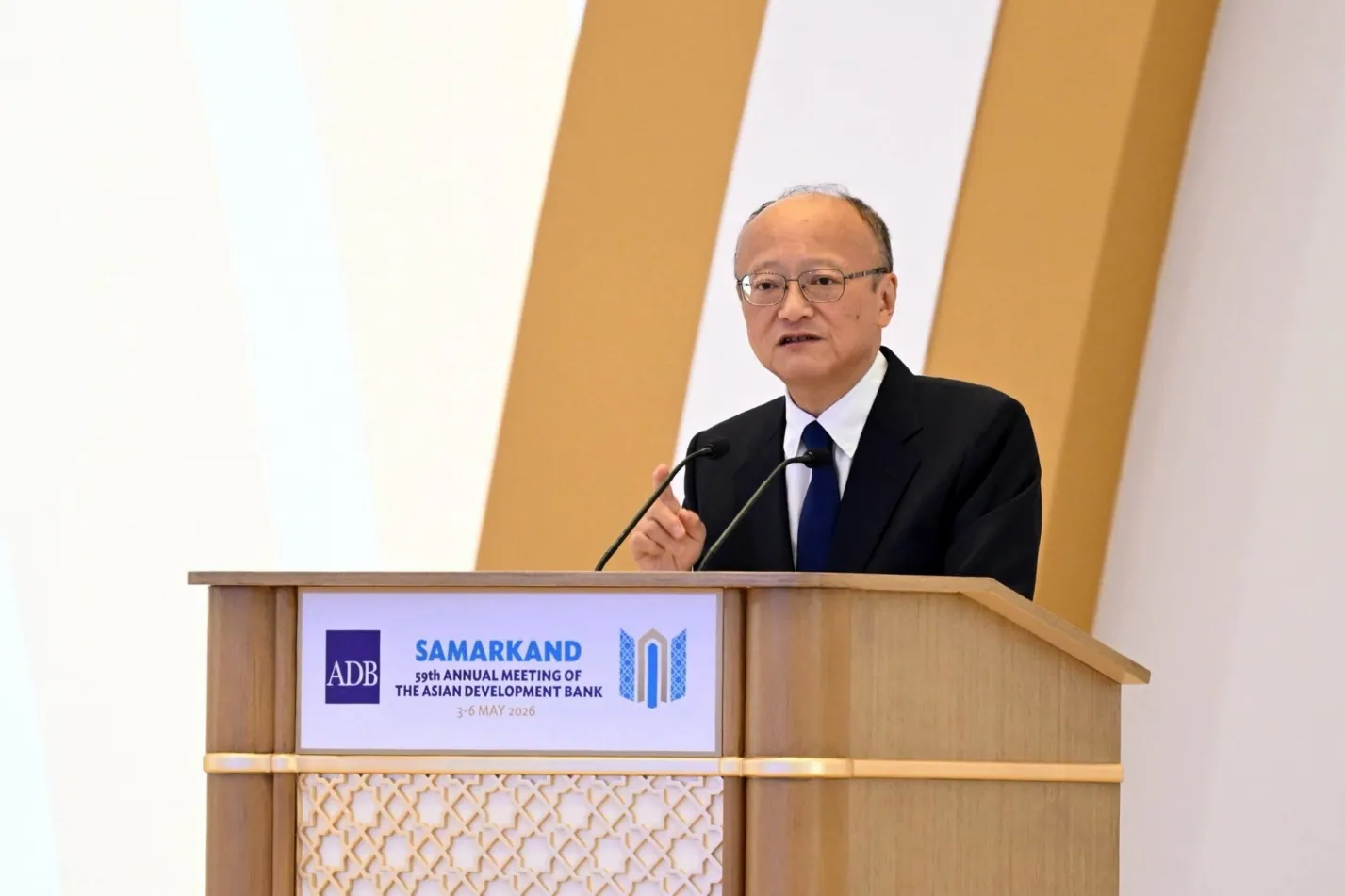
ADB President Kanda opened the meeting by urging regional resilience amid global uncertainty: "to survive and thrive in this new era, we must build deeply connected and resilient systems," he said. Discussions can be grouped around three core themes:
Regional Connectivity and Infrastructure. ADB unveiled a record $70 billion programme (to 2035) to knit together regional power and digital networks. The Pan-Asia Power Grid Initiative ($50 billion) will support cross-border transmission lines and integrate about 20 GW of renewables, extending electricity access to 200 million people and cutting power-sector emissions by ~15%. The Asia-Pacific Digital Highway ($20 billion) will fund submarine cables, terrestrial fibre and satellite links to bring broadband to hundreds of millions in remote areas. These projects are designed to "lower costs, expand opportunity and bring reliable power and digital access to hundreds of millions of people," Kanda said. Other connectivity initiatives highlighted included the China–Kyrgyzstan–Uzbekistan railway, a "Digital Customs and Logistics Alliance" and a "Central Asia Tourist Ring".
Climate and Green Finance. Climate resilience and energy transition were central. The German government joined ADB's Nature Solutions Finance Hub with €5.5 million (about $6.5 million) in grants, earmarked in part for watershed rehabilitation in Uzbekistan. Discussions also addressed food security: ADB experts warned that disruptions (for example around the Strait of Hormuz) are raising costs of energy, freight and fertiliser, "placing additional pressure on food systems" in Asia and Central Asia. Uzbekistan's own green targets featured prominently: the country has already installed ~5.6 GW of renewable energy and aims for 54% renewables by 2030. A new "Bash 2" wind farm (300 MW) in Bukhara was announced: ADB will finance a $116 million package with developer ACWA Power (covering 39 turbines), co-financed by Standard Chartered Bank, while the Asian Infrastructure Investment Bank signed a parallel $107 million loan for the same project.
Private Sector Mobilisation. ADB and partners stressed the need to unlock private investment. ADB's own operations hit record levels in 2025 — $29.3 billion of new approvals (a 20% jump on 2024) — with $5.5 billion committed to private-sector projects (the largest share ever). Japan launched new initiatives in Samarkand to bolster resilience: a $10 billion "POWERR Asia" partnership on energy/supply-chain resilience, and an ACCEL fund to support energy supply firms. An ADB facility for critical minerals (Critical Minerals-to-Manufacturing Financing Partnership) was announced to diversify supply chains for batteries and EVs, reflecting heightened interest (US, EU, Japan) in Central Asia's mineral resources.
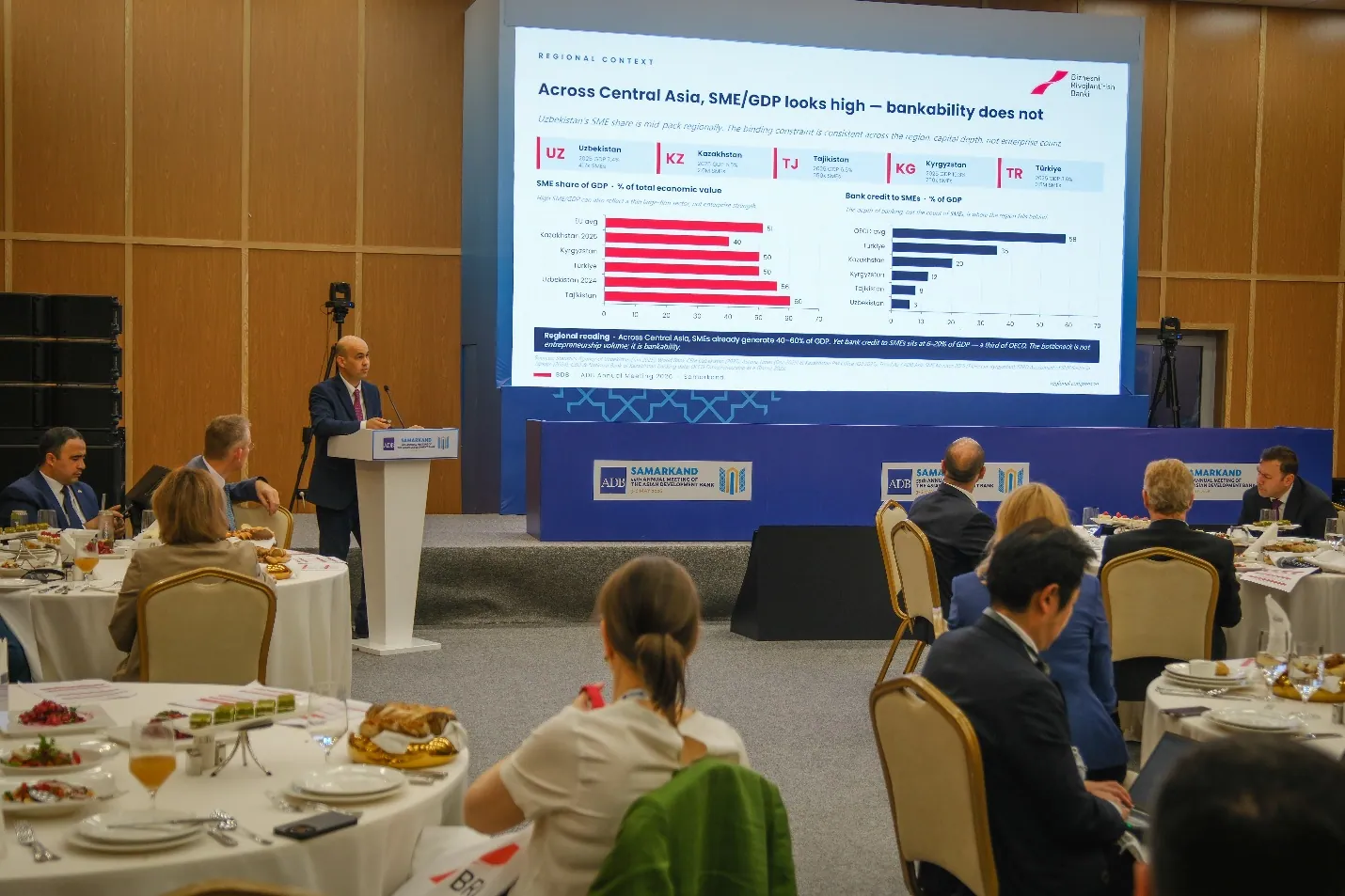
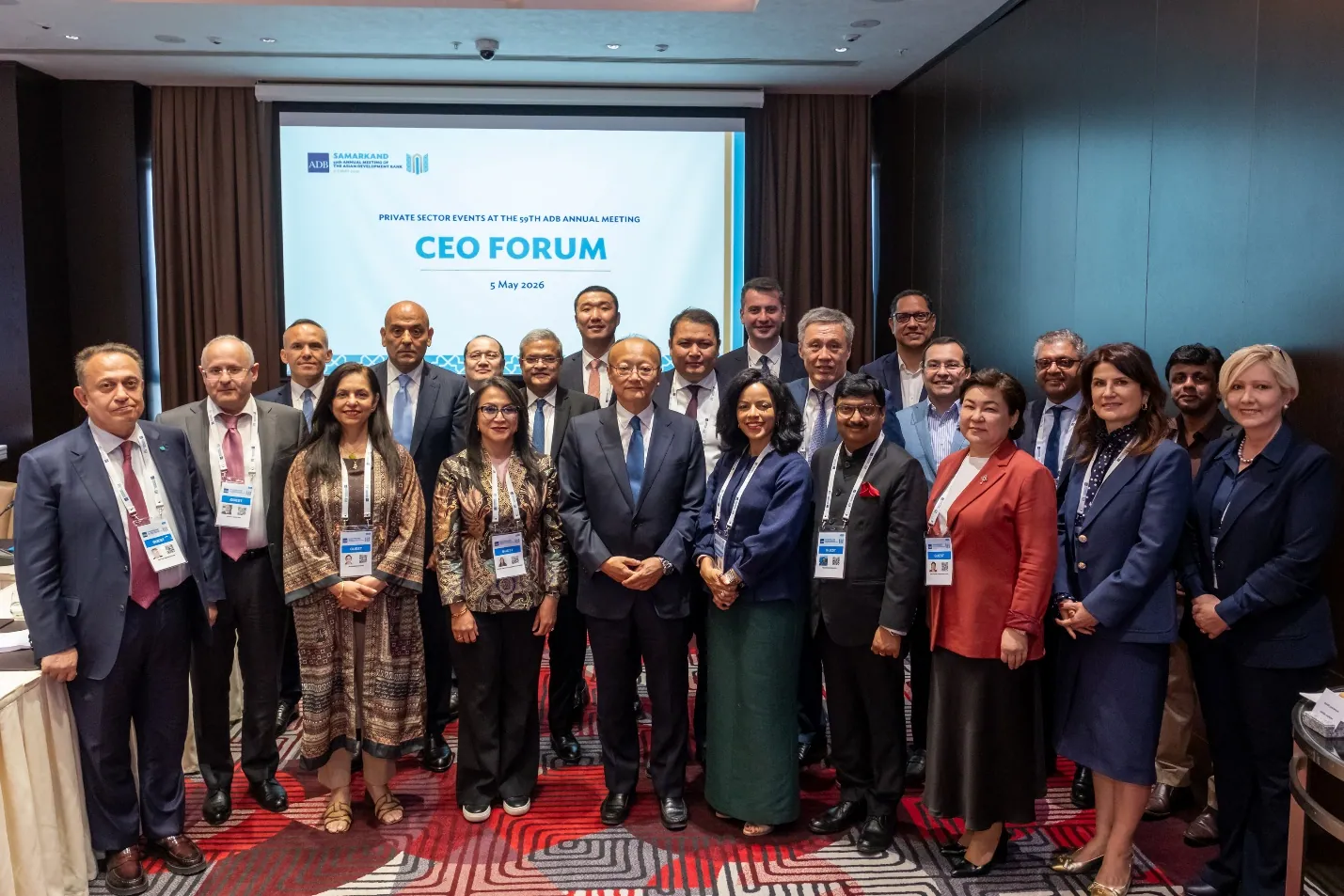
A CEO Forum on 5 May — attended by business leaders and Finasia Capital's CEO — focussed on regulatory and market reforms needed to de-risk investments. Kanda observed that "private sector leadership" is essential, saying ADB will scale up support for digital payment systems, regulatory modernisation, guarantees and risk-sharing instruments to mobilise capital. Japan reiterated support for ADB's "quadrupling private investment financing" goal and announced extra funding to ADB's project-preparation facilities, acknowledging that mobilising long-term capital cannot rely on public coffers alone.
Major Announcements and Commitments
| Announcement / Initiative | Lead Actor(s) | Value / Timeline | Relevance to Private Sector |
|---|---|---|---|
| Pan-Asia Power Grid Initiative (20 GW renewables) | ADB | $50 billion (by 2035) | Reduces power costs, creates opportunities for IPPs and utilities; fosters cross-border trade. |
| Asia–Pacific Digital Highway (broadband expansion) | ADB | $20 billion (by 2035) | Connects 200M people to broadband; builds digital infrastructure for fintech, e-commerce. |
| Nature Solutions Finance Hub (watershed rehab) | Germany + ADB | €5.5 million (grant) | New funding for environmental projects; may spur green investments in agriculture/infra. |
| Uzbekistan Partnership Program (2026–2030) | Uzbekistan + ADB | ~$12.5 billion (total) | Includes PPP projects (mortgages, SME support, infrastructure) to broaden private sector role. |
| Bash 2 Wind Power Project (300 MW, Bukhara) | ADB / ACWA Power / AIIB | $116M (ADB) + $107M (AIIB) | Case study for private-capital funding in renewables; long-term PPA signals stable market. |
| POWERR Asia (energy resilience partnership) | Japan + ADB | ~$10 billion | Support for energy firms and supply chains; potential business for infrastructure and finance. |
| Critical Minerals Finance Partnership (CMM-FPF) | ADB + partners | $20 million (Japan commit.) | Prepares projects to attract private capital in mining and processing sectors. |
Table: Major initiatives announced at the Samarkand meeting, their lead actors and funding, and links to private-sector interests.
Implications for Central Asia and the Private Sector
The Samarkand meeting puts Central Asia squarely on the development map. By promoting projects like trans-regional railways, power grids and digital networks, ADB and its partners are inviting private investors to participate in a "connected future" for the region. Uzbekistan's own reform momentum — from reforming finance to nurturing startups — was showcased as a case study (Mirziyoyev noted ICT and AI hubs and data centre expansion). The emphasis on renewable energy projects (wind farms, transmission lines) suggests opportunities for companies in clean energy, grid tech and green finance. The focus on critical minerals points to burgeoning demand for investment in mining and value-added processing in Central Asia.
For the private sector, these signals mean that regional development is expected to rely on patient, innovative capital rather than just public funding. As one commentator noted, mobilising infrastructure at scale "is not feasible through public resources alone," making blended finance and public-private partnerships crucial.
By attending the CEO Forum and related panels, Finasia Capital gains firsthand insight into investor sentiments and policy direction. The discussions underscored that reforms (e.g. easing regulations, strengthening financial infrastructure) are just as important as raw funding. In Central Asia, where projects often cross borders, having a common digital payments system, data-sharing standards or customs processes will be key to unlocking market potential. The meetings also reaffirmed ADB's strategy of channeling more of its record financing to private ventures — translating into more advisory work, co-financing and capital mobilisation for foreign and local businesses active in Uzbekistan and neighbouring states.
Quote Highlights
"Most importantly, our reforms have focused primarily on improving the daily lives of every single family and individual."
— President Shavkat Mirziyoyev, citing growth and poverty reduction.
"To survive and thrive in this new era, we must build deeply connected and resilient systems."
— ADB President Masato Kanda.
"Connectivity is evolving... It is no longer only about infrastructure, but about how goods, data, and capital move across borders."
— Masato Kanda (LinkedIn).
"ADB's investment in the Bash 2 wind power plant reflects our commitment to supporting Uzbekistan's transition toward a more sustainable energy system."
— Konstantin Limitovskiy, Chief Investment Officer, AIIB.
Conclusion
The Samarkand meeting solidified a vision of Central Asia as a "connected crossroads" for the future. Key themes were integration (physical and digital), sustainability, and leveraging global capital — all with an eye on private sector participation. Major announcements like the $70bn infrastructure plan, the Uzbek-ADB partnership package, and new climate finance pledges set the agenda for the coming year. For Finasia Capital and the investors we advise, the takeaways are clear: growth in the region will depend on public-private collaboration, and Central Asia's governments are signaling openness to external finance and innovation. Our participation at the CEO Forum highlighted that aligning with this agenda — through deals in infrastructure, energy and digital services — can tap into new markets. The next ADB Annual Meeting (May 2027 in Nagoya) will build on these foundations as Asia-Pacific development moves into a more interconnected phase.